

Somewhere in a school hallway, a phone buzzes. A sensor in a restroom has registered a change in the air, and within seconds a notification reaches an assistant principal: an alert, a location, a timestamp. A few minutes later, a student is standing in the office being asked to explain. For everyone involved, the alert feels like the moment the case was made. In legal terms, it is closer to the moment the record began.
That distinction matters more than it first appears. Schools across the country have adopted vape detection technology because the problem it addresses is real: student nicotine use, bathrooms and locker rooms that staff cannot practically supervise, and a genuine need to enforce policies without placing cameras in spaces where students have a reasonable expectation of privacy. But a detection device, however sophisticated, answers a narrower question than the one a disciplinary process must resolve. The device reports that something happened in a place at a time. The school must still determine who was responsible, what the policy says, and what process the student is owed before consequences follow.
It helps to understand what the technology actually measures. Schools comparing the best vape detectors for schools will encounter manufacturer pages such as the linked Zeptive schools page. A manufacturer page can document claimed product capabilities, but it is not independent evidence that any model is “best” for a particular district. Schools should verify detection limits through a building-specific pilot, review the contract and privacy terms, calculate total operating cost, and record the criteria used to compare systems. Regardless of vendor, these devices do not see, film, or identify anyone. They sample the air for changes associated with vaping aerosols and send an alert when configured thresholds are crossed. The sensor detects an environmental event. It does not detect a person.
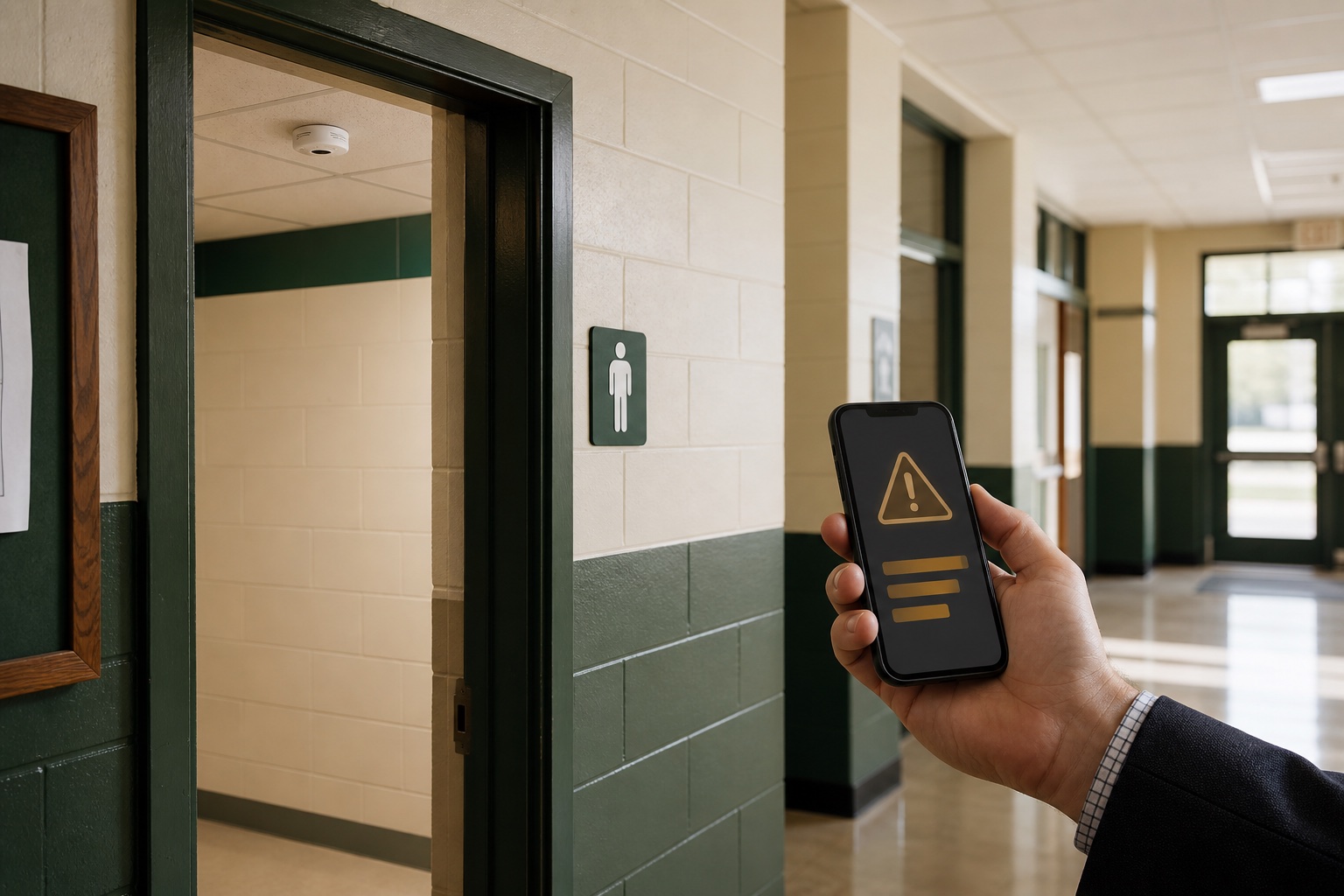
The gap between an event and a person is where school discipline either holds together or falls apart. An alert logged at 10:14 a.m. in the east-wing restroom is a fact. The conclusion that a particular student vaped is an inference, and an inference is only as strong as the corroboration around it. Which students entered or left the restroom around that time? Did a staff member respond quickly enough to observe anything useful? Was there a second alert, a pattern, a prior report? None of these questions diminishes the technology. They simply recognize that the alert is the first layer of a record, not the final one. Schools that treat it as a starting point tend to make defensible decisions. Schools that treat it as a verdict tend to make vulnerable ones.
Privacy is the second axis of the analysis, and it cuts in an interesting direction. Detection systems are frequently chosen because they protect privacy: they allow monitoring of spaces where cameras would be unlawful or unacceptable. Yet the same deployment still creates a data trail, and that trail has its own legal life. How long are alerts retained? Who can access the logs? Are alerts ever combined with other records, such as door-entry data or hall passes, in ways that effectively track individual students? Is the data stored by the vendor, the district, or both, and under what terms? These are not hypothetical concerns. A well-drafted policy answers them in advance, in writing, so that the first hard question about the system does not arrive in the middle of a dispute about a specific child.
Then there is due process, the oldest layer under this newest technology. In the public school context, the baseline remains the principle associated with Goss v. Lopez, 419 U.S. 565 (1975): before a student faces a real suspension, the student is entitled to notice of what they are accused of and an opportunity to respond. A sensor alert changes nothing about that obligation. If anything, it sharpens it, because an alert can create an aura of scientific certainty that tempts everyone to skip steps. The better practice is boring and robust. Tell the student what the alert says and what else the school is relying on. Let the student respond. Document both. If the response reveals a plausible alternative explanation — a blocked sensor, a crowded restroom, a malfunction window — record that too. A process that can absorb an inconvenient explanation is a process that will hold up when it matters.
Policy language deserves the same care. The strongest policies define what an alert triggers rather than what it proves. An alert can justify a timely, non-invasive response: a staff member checking the area, a log entry, a conversation. Escalating consequences should rest on the totality of what the school actually knows, not on the alert alone. Policies should also distinguish between categories of alerts where the technology does — a detection event is different from a tamper warning or a noise flag — and should avoid promising accuracy the devices do not claim for themselves. A policy that overstates the technology is not stronger for it. It is simply easier to challenge.
Finally, the recurring theme of this blog: the record. If a detection system is in place, the alert logs, the response notes, the policy text, the retention rules, and the student's own account together form the layers that any later reviewer — an administrator, a school board, a hearing officer, occasionally a court — will actually examine. Those layers are written in the ordinary days before anyone imagines a dispute. Consistent logging, honest incident reports, and a habit of documenting exculpatory details with the same care as incriminating ones are what make the record readable later. A single dramatic alert, stripped of context, persuades for a week. A clean, layered record persuades for as long as the decision is questioned.
None of this is an argument against detection technology. Schools have a legitimate interest in healthy air, enforceable rules, and supervision that respects student privacy, and well-designed sensors serve all three. The argument is for calibration: let the device do what the device does, and let people do what only people can do — investigate, listen, decide, and document. The alert is not the evidence. It is the first sentence of the evidence, and the rest still has to be written carefully.
This article is general information, not legal advice. For advice about a specific situation, talk with a qualified lawyer in your jurisdiction.